
The Malaysia–Hong Kong–Russia Chip Pipeline
A Chinese reseller offered to ship advanced Nvidia servers from Malaysia to Russia


Wirescreen analysis has identified several Chinese companies that claim to resell restricted Nvidia chips to Russia via warehouses in Hong Kong, including at least one company that says it has sourced these chips from Malaysia. The offerings illustrate the challenge of enforcing U.S. chip controls across borders.
Nvidia has drawn scrutiny in recent weeks for its failure to block China’s access to restricted chips. Universities with close defense ties such as Tsinghua University have obtained restricted chips, and companies advertise access to these chips openly on their websites and in product catalogues. After reports tying Chinese imports of restricted chips to companies operating in Malaysia and Singapore, on Nov. 16 the U.S. Bureau of Industry and Security (BIS) issued new rules placing licensing requirements on semiconductor shipments to Malaysia, Singapore, Thailand, Indonesia, and Brazil.
Many Chinese companies participate in a thriving international market for advanced Nvidia chips. Dozens of Chinese vendors on Ali Express, an international business-to-consumer online marketplace owned by Alibaba, list restricted Nvidia products for sale, including H100, H200, and Blackwell GPUs. These companies are typically registered in China and say their products are stored in warehouses located in Hong Kong or elsewhere abroad.
It is legal for third party dealers to sell advanced chips to countries that aren’t subject to an export ban. But chip resales are often opaque, and open up the risk of transshipment to buyers located in restricted markets.
Hong Kong is known to be a key hub for illicit semiconductor transshipments to Russia. The U.S. restricted Russia’s access to advanced semiconductors after Russia’s invasion of Ukraine in 2022. China is now Russia’s largest supplier of advanced chips, providing 88 percent of its chips by dollar value, according to one estimate. Russia is not developing frontier AI models, and its AI and chip-making industries are far behind the U.S and China. Russia uses advanced chips primarily to support its defense industrial base.
WireScreen has identified several Chinese companies that use public Telegram channels to advertise Nvidia chips for sale to Russia, including for military use.
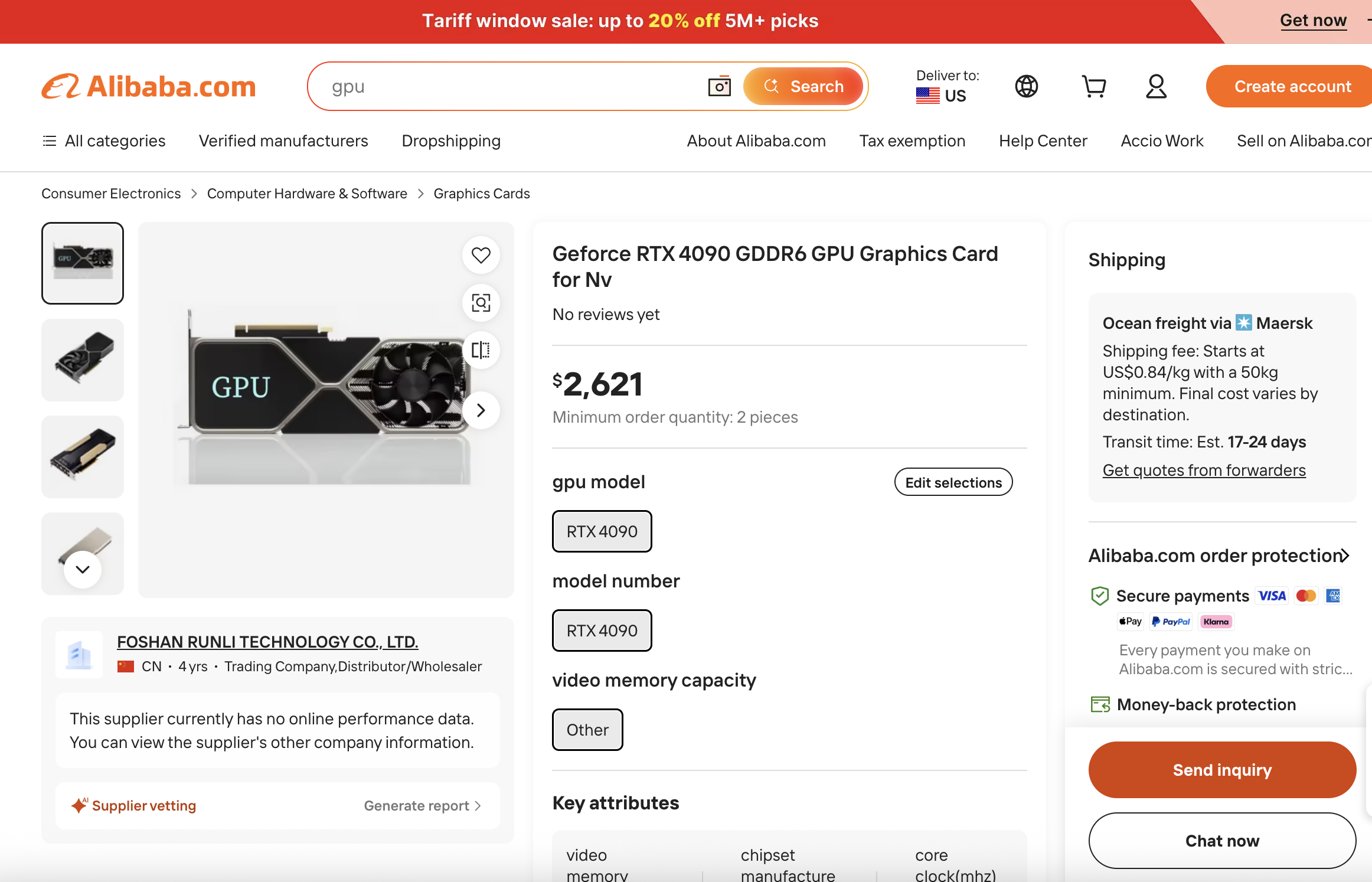
One of these, Foshan Runli Technology Company, or Runli Tech, is a Chinese company registered in 2017 and based in the southern Chinese city of Foshan, according to WireScreen data. Runli Tech has operated an Alibaba storefront for four years, according to its page on the e-commerce website, where it lists Supermicro, Dell, XFusion, and Lenovo products for sale. The company’s offerings on Alibaba also include restricted Nvidia products, such as the Geforce RTX 4090, listed as originating in Hong Kong.
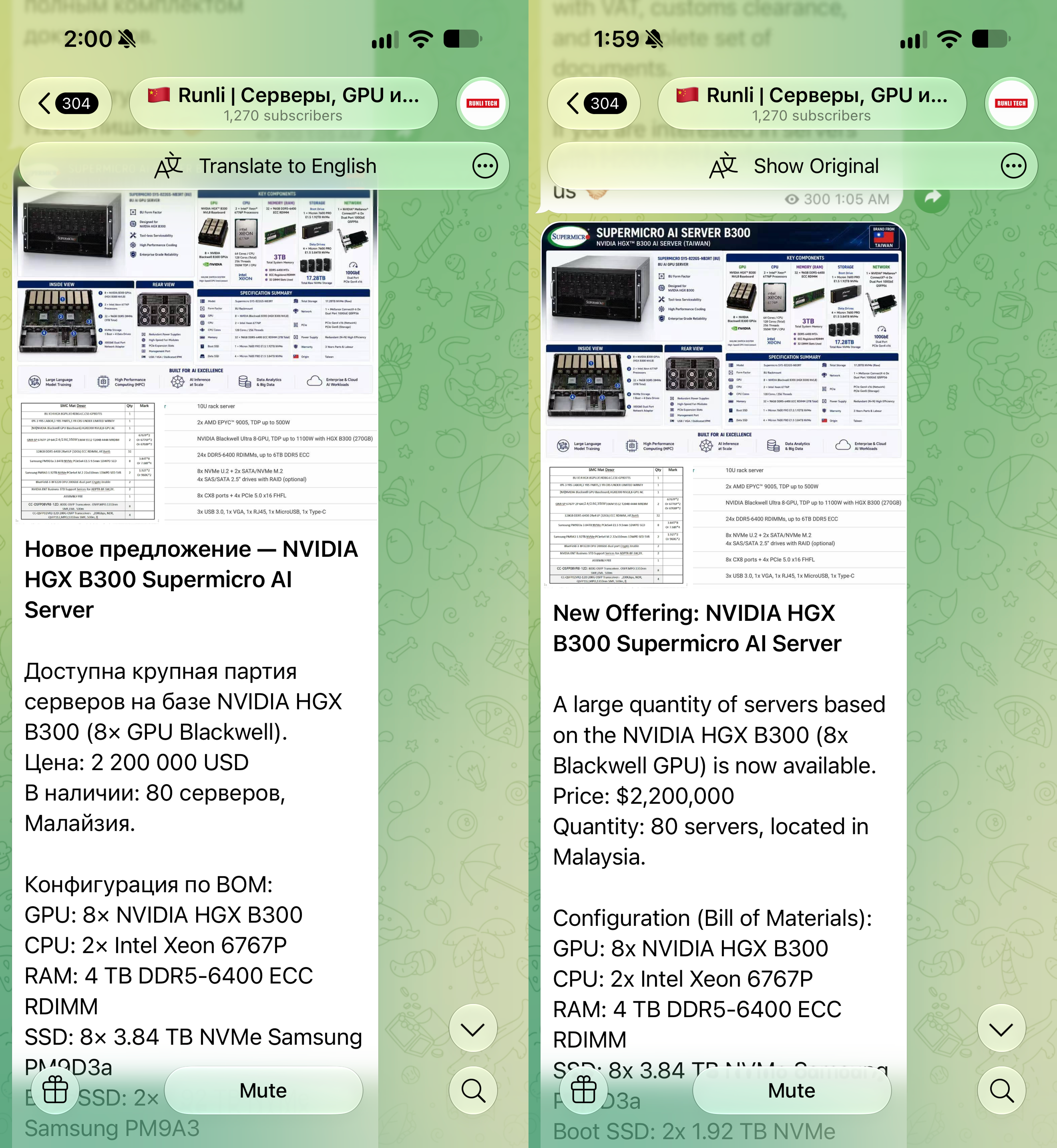
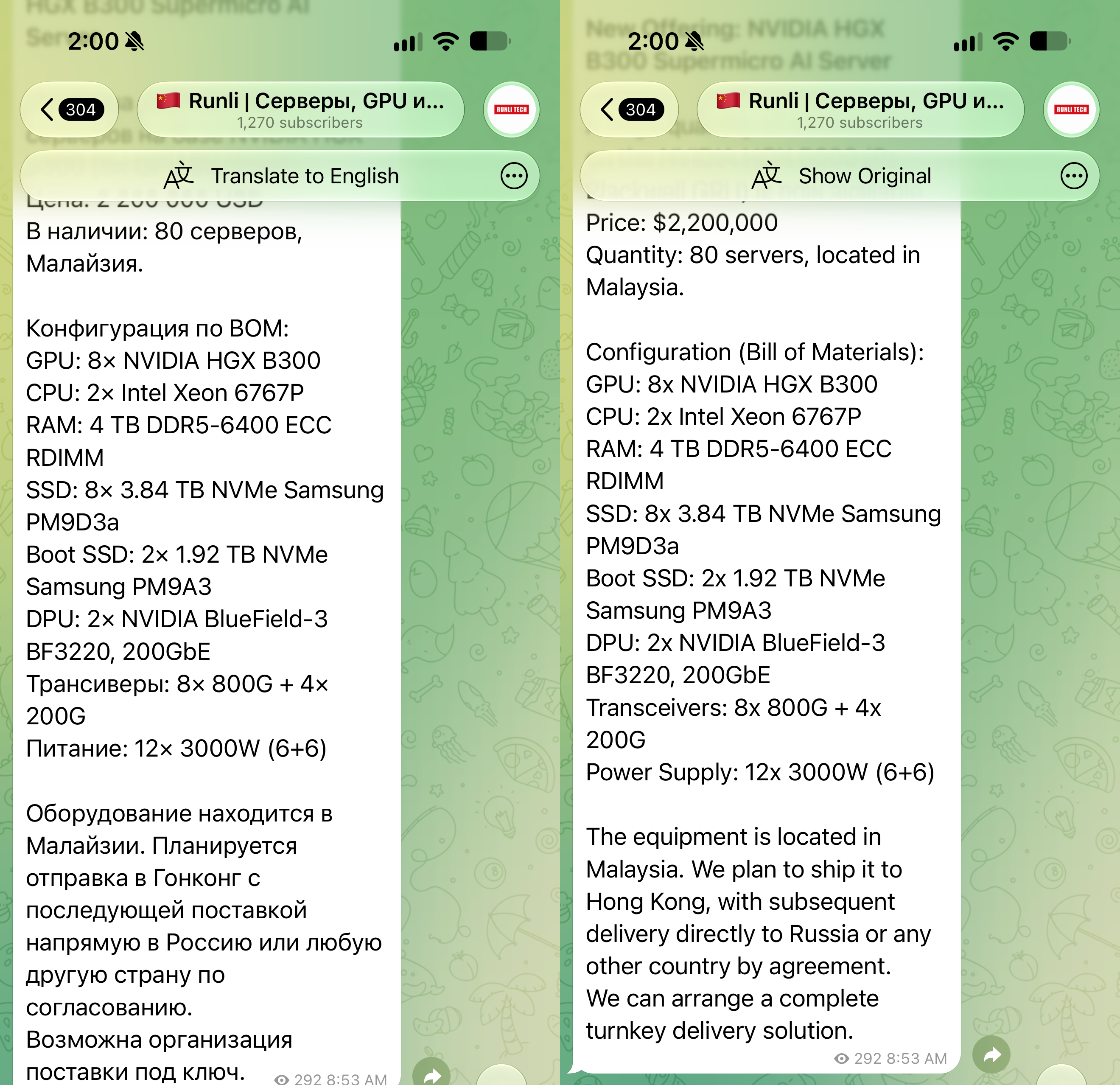
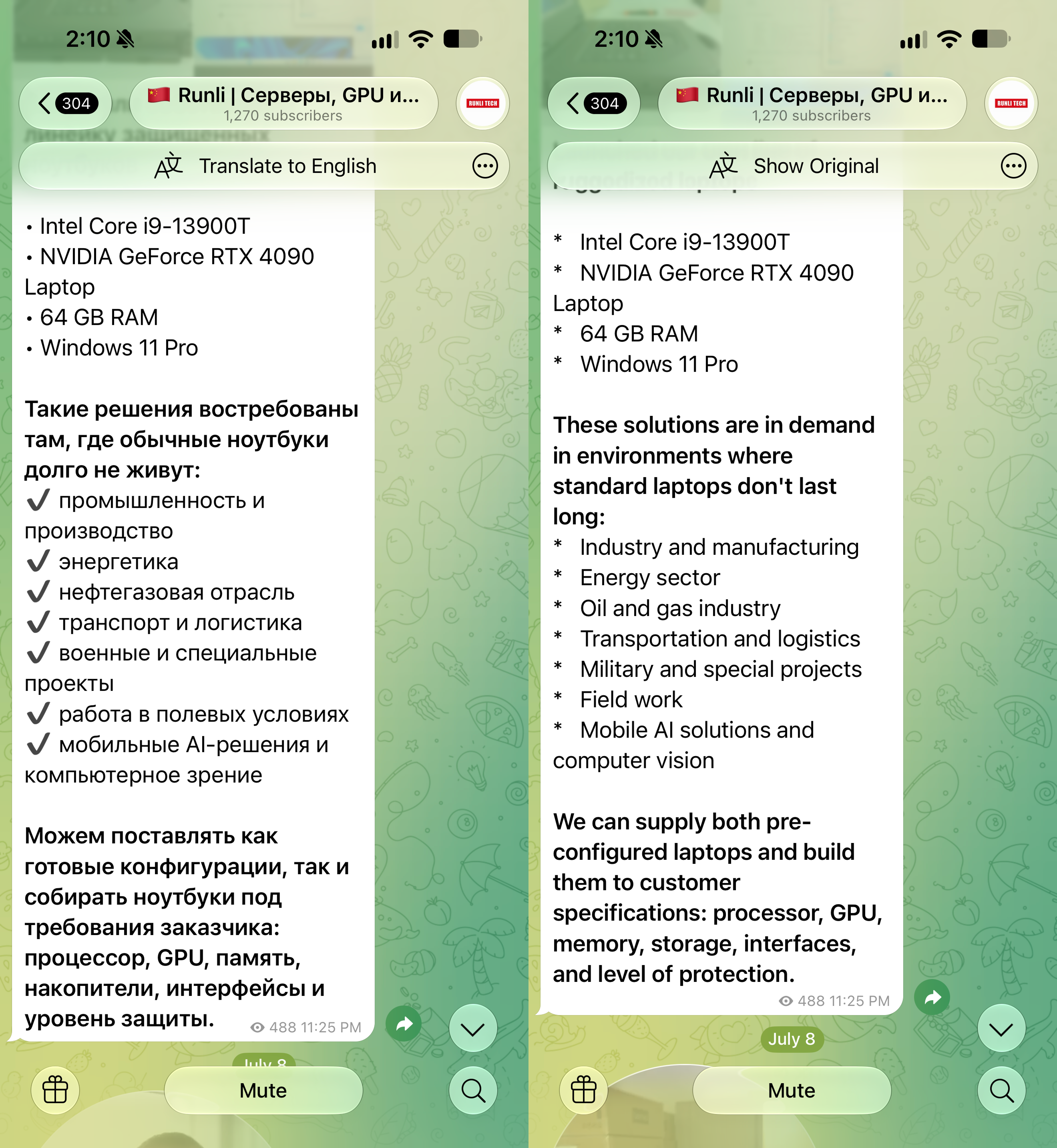
Runli Tech also operates a Russian-language channel on Telegram where it posts photos of advanced hardware, including Nvidia’s H100 and H200 chips and Blackwell GPUs. The company described equipment as available in Hong Kong, Guangzhou or Shenzhen, and available for shipment to Russia.
Runli Tech declined to comment.
Runli Tech created the Telegram channel in July 2023. Since November 2025, it has posted dozens of advertisements for restricted chips and GPUs. Numerous posts imply or state directly that Runli Tech imports Nvidia products from Malaysia for resale to Russia. On October 12, the company said it was selling 80 servers equipped with Nvidia HGX B300 chips. “The equipment is located in Malaysia,” the company wrote. “We plan to ship it to Hong Kong, with subsequent delivery directly to Russia or any other country by agreement.” HGX B300 chips are restricted for shipment to both China and Russia.
On September 15, the company posted that it has a server equipped with eight Nvidia B300 chips “currently available in Malaysia” that can be delivered to Russia. In a November 19 post, Runli Tech wrote that the new BIS rules could pose new barriers for Russian buyers. “Having GPUs in stock in Malaysia or Hong Kong no longer guarantees the possibility of legal re-export,” the company wrote. “The route Malaysia → Hong Kong → Russia does not, in itself, eliminate U.S. export controls.”
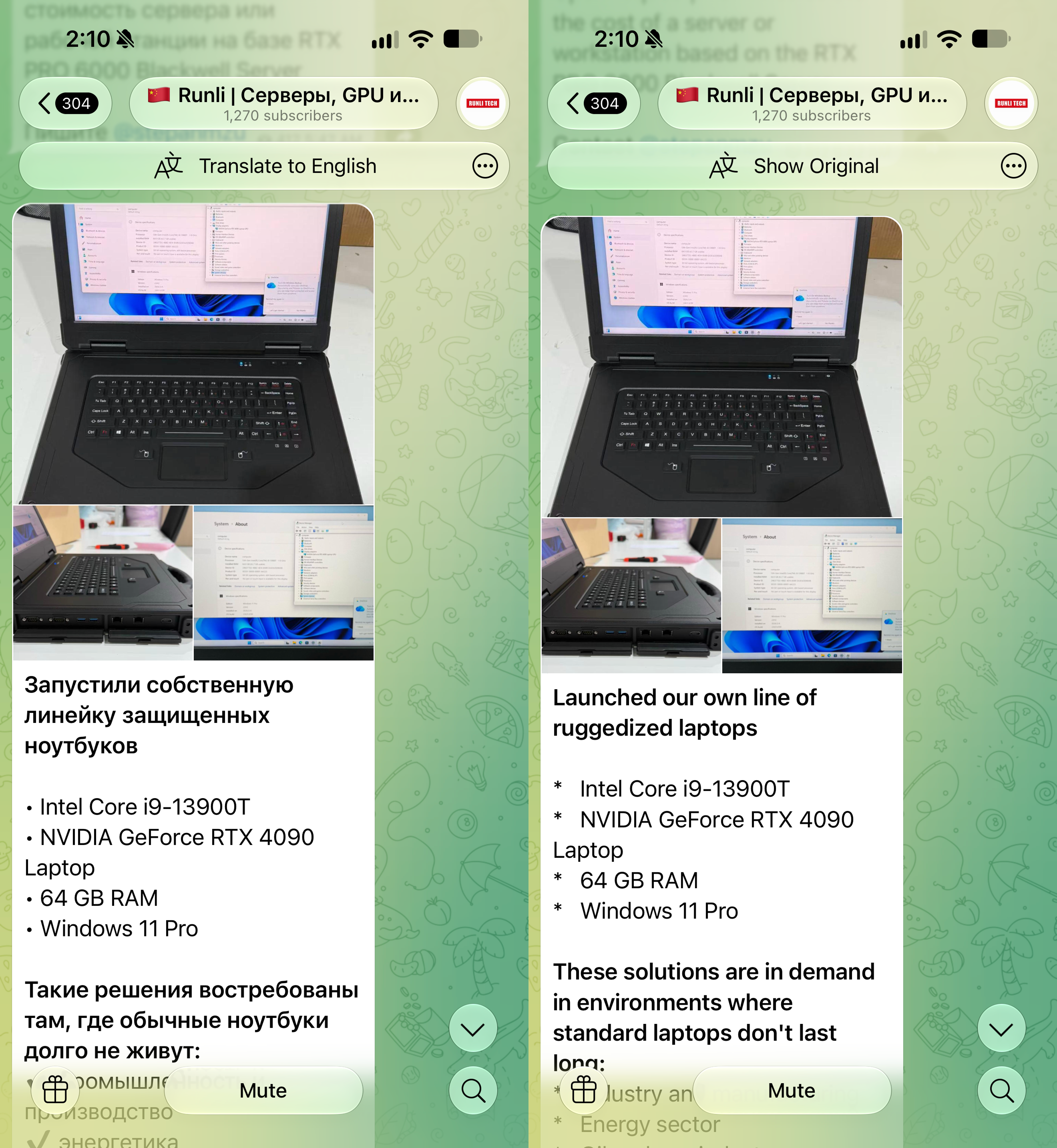
Other posts indicate that the products on offer are made for military use. In a July 5 post, which included a photo of a laptop, Runli Tech said it had launched its own line of “ruggedized laptops” equipped with Nvidia GeForce RTX 4090, which is restricted for shipment to both China and Russia. The laptops are designed for “environments where traditional laptops don’t last,” including “military and special projects,” the company wrote.
Numerous posts also offer servers equipped with Nvidia H100 and H200 chips, sometimes available for bulk purchase. An October 12 post offers two Lenovo servers, each equipped with eight Nvidia H200 chips totalling 1.128 terabytes of GPU memory. “These servers are suitable for AI clusters, neural network training, LLMs, and high-performance computing,” Runli Tech wrote. “We can arrange delivery to Russia, including official import with VAT [value-added tax], customs clearance, and a complete set of documents.”
A review of trade data from the website 52WMB showed that Runli Tech has made shipments of semiconductors and servers to Russian companies within the past three years, and that some were transported from Hong Kong to Russia. WireScreen was not able to determine if those shipments contained restricted chips.
One of Runli Tech’s Russian customers was PSK Patriot, a St. Petersburg electronics company that says it supplies equipment under Russian state defense orders. In October 2026, the European Union sanctioned PSK Patriot, citing its role in Russia’s military-industrial complex. WireScreen could not determine how the equipment was used or whether any shipment contained restricted Nvidia chips. The trade records do not identify the processor manufacturer or establish that any shipment contained restricted Nvidia chips.


